The Candlelight Hour
An hour a week in softer light. The room looks different, and so does the conversation.
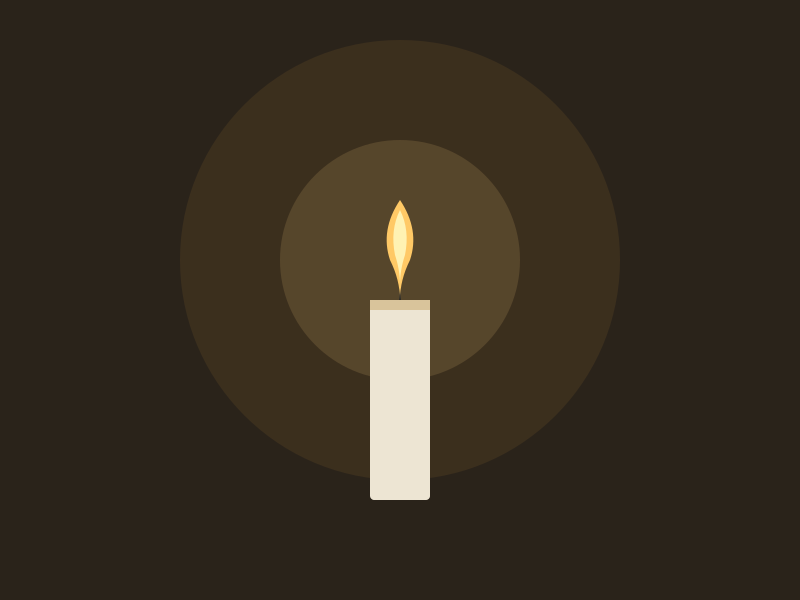
Pick a night. Pick an hour. Turn off the overhead lights, turn off the screens, light a candle, and sit in the room you already use most. A few dollars for a candle, and about forty-five minutes of attention you were probably going to spend in bluer light anyway.
The candlelight hour is not a romance trope, though the lighting cooperates with the trope. It is a small weekly exercise in letting a familiar room look different, and in letting the people in the room, including you, become easier to listen to.
Why the light changes the room
A candle puts out roughly thirteen lumens. A ceiling fixture puts out between six hundred and twelve hundred. Under overhead light, a room appears as it is inventoried: surfaces, edges, corners, objects. Under candlelight, the same room is reduced to the faces of the people in it and the small circle of warm color on whatever table the candle sits on. Everything else falls back. It is a huge perceptual shift produced by a tiny technological intervention.
What people do under candlelight is different from what they do under overhead light. Speech slows. Posture softens. Silences feel less awkward. If other people are in the room, the quality of conversation tends to deepen by one turn. Alone, the room becomes a quieter companion than it is at normal brightness.
The equipment
One plain candle is enough. A beeswax taper, an unscented pillar, a small tea light on a saucer. Scent is optional and can be distracting. Strongly perfumed candles produce a different kind of room than the ritual is aiming at. Keep one candle on a surface (table, desk, windowsill) you can see from where you sit.
Have matches or a lighter in the same drawer. Friction defeats rituals. If you have to hunt for matches every time, the ritual will happen six times and then stop.
Keep a simple holder that catches the wax. A small dish is fine. The point is to avoid, over months, a small resentment at the wax stains on whichever table you chose.
Speech slows. Posture softens. Silences feel less awkward.
When to do it
Most households that adopt this ritual land on a Friday or a Sunday evening. Friday makes a gentle welcome to the weekend. Sunday makes a soft edge against the return of Monday. Pick the night that is structurally easiest: the one with the fewest interruptions, the fewest incoming phone calls, the smallest chance of a doorbell at 8:12.
The specific hour matters less than the consistency. The same night each week, with the same candle in the same spot, accumulates into a recognizable edge of the week. "Our Friday candle" enters the household vocabulary inside a month.
What to do during the hour
Whatever you would have done during an ordinary lit hour, in different light. A book, if that's the usual. A shared dinner, if that's the usual. A conversation with someone you live with. The instruction is not to meditate by candlelight. It is to let an existing activity be reilluminated, literally.
One gentle constraint. Screens interfere with the perceptual shift, because a laptop produces more lumens than the candle. Close the laptop. Put the phone face down on a table in another room. The hour goes quickly if the only light sources are the candle and what falls in through the windows at that hour of the evening.
Alone, or with someone
Both work. Alone, the hour tilts toward contemplation: a book, a notebook, a slow drink, a quiet house. With another person, it tilts toward conversation, the kind that requires the phone to be somewhere else and the light to be friendlier to faces.
Couples who adopt this ritual often report that they fight less during the hour. This is not because candlelight has mystical properties. It is because the combination of no screens, softer light, and a shared unstructured hour is a combination they had not produced on purpose before. The hour is the container; what happens inside it is the dividend.
Safety, briefly
Never leave a candle unattended. Blow it out before leaving the room. Keep it away from paper, curtains, and the edges of shelves. These are the only rules. A small metal lid on the jar, or a snuffer, is a nice small investment after the third or fourth week.
This Friday
Buy one candle. Put it on the kitchen table. Light it after dinner, turn off the overhead light, and sit for an hour. See whether the room is different. See whether you are.